Review by Pamela Hickman (Israel)
“Violets Are Blue”, early keyboard artists Diana Weston and Michael Tsalka’s most recent recording, takes us into the world of childhood. Drawing inspiration from Béla Bartók’s “For Children”, Weston and Tsalka requested works associated with childhood from four contemporary women composers. We hear the works performed on harpsichord and fortepiano.
Well before embarking on the “Mikrokosmos”, Bartók composed “For Children” (1908-1911), a comprehensive collection representing the research into folk-song he had carried out together with Zoltán Kodály. The first volume is based on Hungarian folk tunes, with the second, on Slovakian tunes. The pieces have descriptive titles, referring to songs or dances. Tsalka and Weston arranged and performed a few pieces from each collection. Choosing to play five from the Slovakian Folk Tunes on square piano, Tsalka performs them with personal expression and charm, pacing each thoughtfully, signing out with the Dirge, its left-hand melody graced by the haunting, repetitive ringing of bells allotted to the right hand. For pieces based on the Hungarian Folk Tunes, Weston’s playing on harpsichord is animated and dancelike, the last piece (No.25) turning to introspection. For our young pupils, the pieces, suited to what small hands can manage, offer fine study material and plenty of variety. To our adult ears, they are exquisite, whole compositions. The artists’ playing of these miniatures, each perfectly fashioned and characterized by the modes and authentic rhythms of those regions, emerges transparent, convincing and fetching.
Commissioned by Diana Weston, “Hopscotch” (2025) by Ann Carr-Boyd (b. 1938, Australia) sits very well on early keyboards. Weston and Tsalka give zesty expression to Carr-Boyd’s articulate, accessible language and to the almost-visible chronicles in which she embraces memories of children at play, the graceful movements (and music typical) of a ballet class, and we are also invited to envisage the drift of “I Hate Spinach”.
“The Rain Puzzle”, by Australian composer Elena Kats-Chernin (b. 1957, Uzbekistan) is a fascinating piece. Adhering to the work’s harmonic course and structure, the performer is at liberty to decide on dynamics, tempo and even on the choice of keyboard instrument(s). Choosing to play this perpetuum mobile on the fortepiano, Weston’s performance takes the listener beyond the lightweight pitter-patter of raindrops that taper off now and then, yet never cease. Following each basically tonal harmonic process to its port of call becomes an intricate part of probing the puzzle.
By another Australian composer, Diana Blom (b.1947, New Zealand), “Ballpark” for two harpsichords offers a series of clever depictions of the actions and pace of a number of ball games. This is spirited, characterful writing for two harpsichords, here performed with meticulous precision.
The selection of pieces from “Märchen” (Fairytales) by Violeta Dinescu (b.1953, Romania, in Germany since 1982) presents a rich potpourri of characters, situations, descriptions and short narratives sure to fire the imaginations of young listeners and of those of us adults reluctant to leave the world of fairytale fantasy. On this recording, some pieces are played on square piano (Tsalka), some on harpsichord (Weston) and a handful on both. Dinescu does not limit her style to any one tonal system, rather, making use of tonal-, modal- and/or atonal writing in order to create each tiny, finely-etched vignette, be it a description of some strange hybrid creature, the lure of magic, of a princess in a tree, Caspar’s hen laying some notes, Grandmother’s music box, a puzzle, and more. Then, with the artists performing in duo on square and harpsichord, we hear several more miniatures (this time untitled) from “The Story Book of My Grandma”, Dinescu again employing various compositional strategies and including a touch of folk idiom. In keeping with the fact that this second collection includes some aleatoric elements (suggested by whimsical graphic signs), the pieces were recorded live, undergoing no editing.
The art of performing miniatures is of the essence in “Violets Are Blue” – contemporary music for square piano and harpsichord. Dr. Diana Weston (Australia) and Prof. Michael Tsalka (Israel-China) address every fine detail and gesture, reading into each piece in depth with new curiosity and commitment. Their playing is polished, exhilarating and inventive, exhibiting fine teamwork. This delightful line-up of works calls for active listening. Recorded in Sydney, Australia, September 30th 2025 for the Wirripang label, the artists perform on a Flemish single-manual harpsichord (Marc DuCornet), a Zuckermann single-manual harpsichord and a restored square piano forte by Robertson (c.1835), Liverpool, England.
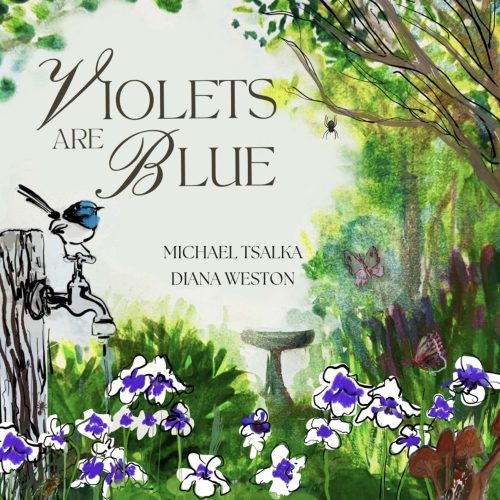
Violets are Blue

From Violeta Dinescu:

I would like to tell you that in recent times the selection of CDs that receive reviews has become increasingly demanding. Only very few CDs receive attention in the German-speaking world, and those not produced in Germany often have little or no chance of being considered.

All the more, I am delighted to send you this very positive review, and I would like to thank you once again. Violeta Dinescu, composer (Romania, Germany)
Review in Klassik-Heute
Sound quality:9/10
Overall impression:9/10
There’s no other way to put it: Michael Tsalka and Diana Weston have recorded a highly unusual CD. They dedicate themselves to the combination of the square piano – which is a rarity in itself – and the harpsichord. The result is a truly exceptional CD, not only because of the choice of instruments. The repertoire that Tsalka and Weston have recorded is also rare. Perhaps the best-known pieces are some by Béla Bartók, from whose works the two performers play a selection of shorter pieces based on Slovak and Hungarian melodies. This works perfectly, as the archaic quality of these pieces suits the sound of the square piano and harpsichord well
Playful, yet sophisticated
Hopscotch, a short suite by Ann Carr-Boyd, is a delightful piece with a playful character, which the performers interpret as such. The same can be said of Violeta Dinescu’s pieces from the cycle “Fairy Tales.” Composed specifically for this recording, it allows the performers the freedom to choose which instrument to play them on. The music has a playful yet highly serious impetus; it is entertaining and is performed accordingly. Works by Elena Kats-Chernin and Diana Blom round out this unusual but very varied and amusing recording, which is recommended not only to lovers of the unusual and rare.
Guido Krawinkel [February 27, 2026]
http://www.klassik-heute.com/4daction/www_medien_einzeln?id=25357